Nurturing Persistence and Choice in Children
November 10, 2025

“If persistence be the true foundation of the will, we nevertheless recognize decision as the act of the will par excellence.” 

— Dr. Maria Montessori, Spontaneous Activity in Education


In this quote, Dr. Montessori reminds us that persistence is at the heart of character development. Today, we might call this steadiness and perseverance “grit.” 


When children work through obstacles and remain committed to their chosen activity, they are not only building skills. They are forming the very foundation of their will.


Take this typical scene from a Montessori classroom: a four-year-old works with decimal system materials, building four-digit numbers using beads and cards, staying with the activity for an extended period of time, repeating it again and again with intensity and focus. The child gives as much attention to the careful set-up and clean-up as to the work itself. 


It’s easy to imagine this young person years later as a hard-working, thoughtful, responsible individual. The four-year-old’s persistence in that moment shapes the future self, strengthening the ability to act with purpose in life.


Decision: The Act of the Will


If persistence is the foundation of the will, decision is the act of the will. And every decision arises from choice. For children, the ability to make choices is essential. Just as movement cannot develop when children are kept immobile, the will cannot develop if children are never given the chance to choose.


Our entire life is a continual exercise of decisions. This ability to choose builds independence. When children cannot make their own decisions (or when they fear making the wrong one), they become dependent on others.


This is why choice is such an important part of the Montessori environment. We strengthen children’s will by continually offering opportunities to decide. The choices don’t have to be large ones. They can be woven gently into the day:


  • Would you like to carry the tray or the mat?
  • You may choose any table.
  • Would you like to put the box or the pencil away first?


Each small decision helps strengthen the will.


Independence Through Choice


Every time children make a decision, they are practicing independence. They are learning to trust themselves instead of depending on the suggestions of others. They decide when to begin and when to finish, when to move and when to pause, when to be quiet and when to speak.


One of our jobs as adults is to ensure that we are giving children opportunities to practice using their will. Just as we don’t keep children motionless when they are learning how to crawl, cruise, walk, or run, we don’t want to impede children’s will when they are learning how to make choices and act upon their environment. 


“And yet we do something of the same kind when, in order to educate the child’s ‘will,’ we first of all attempt to annihilate it, or, as we say, ‘break' it, and thus hamper the development of every factor of the will, substituting ourselves for the child in everything.” 

— Dr. Maria Montessori, Spontaneous Activity in Education


This is a cautionary reminder for us as adults, as we can all too easily impose our will upon our children. This can happen in overt, overly controlling ways, or it can happen more subtly when adults do things for children rather than allowing them to practice making choices and experiencing consequences.


As Montessori parents and guides, our role is to protect this space for choice. By doing so, we are supporting children’s independence in the present, while also helping them build the persistence, decision-making, and strength of will that will guide them for life. 


Curious to see how this works in a classroom? Schedule a tour here in Bozeman!

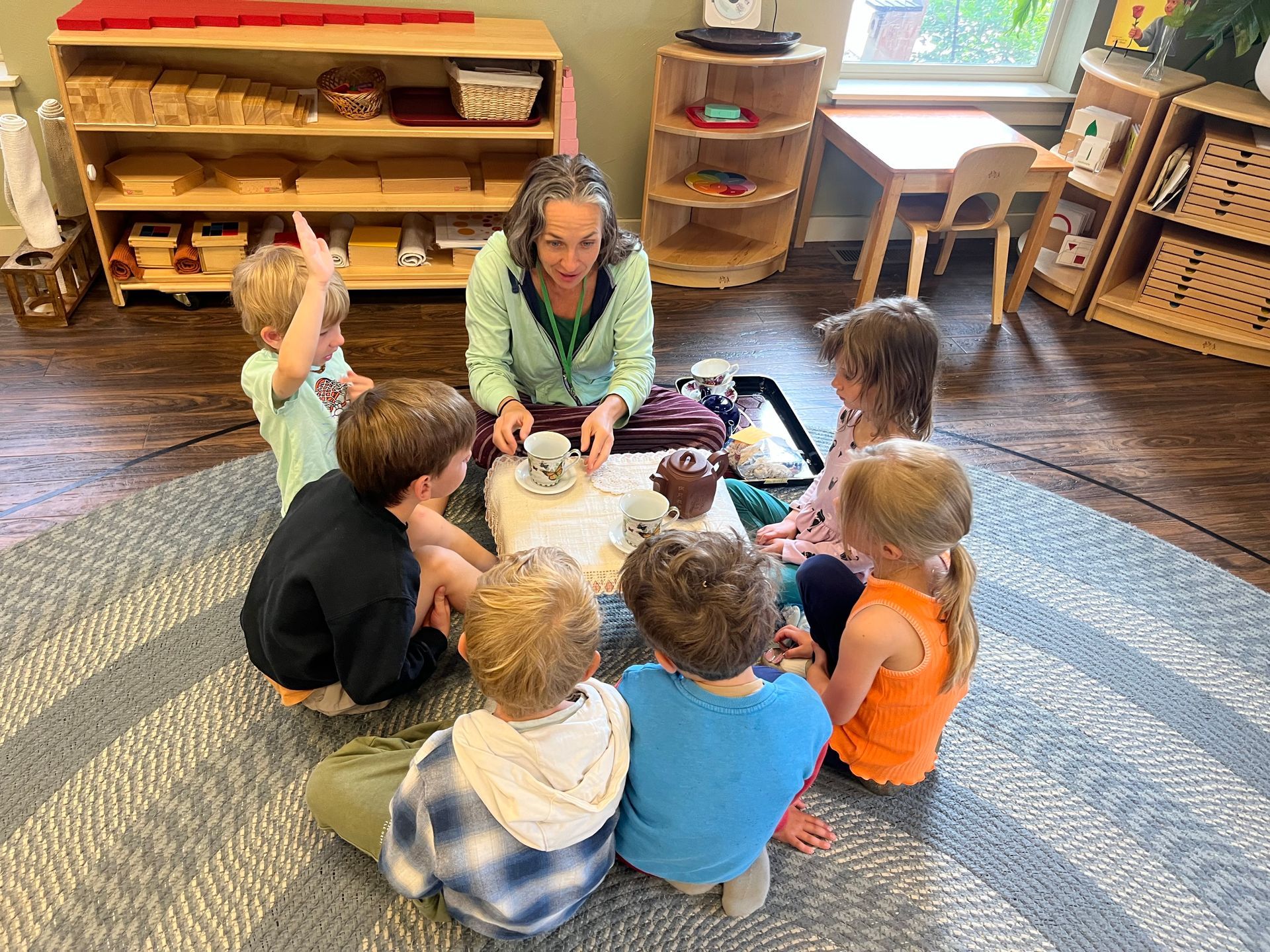
montessori children with guide in tea lesson
June 26, 2026
We’re opening our doors for a special campus tour and we'd love for you to join us!
Three young children sitting on a couch, smiling in a bright indoor room.
June 15, 2026
Connect the Montessori classroom to nature. Discover how exploring Montana’s rivers helps young children develop spatial awareness and environmental respect.
Two children kneel on a classroom rug behind a colorful block maze on the floor.
June 1, 2026
In the Montessori tradition, we talk a lot about "following the child." Sometimes people mistake this for letting a child do whatever they want. But as those of us who have been in the trenches know, following the child actually means observing them through developmental periods so thoughtfully that we understand what they need before they even have the words for it. When it comes to mental health, this observation is our greatest tool, as it helps us prepare. Mental health in childhood includes resilience, the security of belonging, and the development of an "inner voice" that tells a child they are capable, eventually serving as their source of internal guidance. Supporting this development requires us adults to shift from being managers of their behavior to loving guardians of their emotional environment. The Foundation: Safety and Routine For children in the first plane of development (birth to age 6), the groundwork for mental health is laid through warm, secure relationships. In Montessori terms, this is the "prepared environment” of connection. We often say that children need consistency like they need air. We provide stability through routine—not a rigid schedule, but a predictable rhythm. When a child knows what comes next, their nervous system relaxes. Simple acts like involving them in everyday moments—letting them slice a banana or fold washcloths—give them a sense of agency. A child who contributes to the world around them is a child who feels capable and valued. This sense of "I can do it" is important, and sometimes we just have to get out of the way. The Elementary Years: The Why and the Who As children move into the second plane of development (ages 6–12), their mental health needs shift toward social belonging and moral understanding. This is the age of "Why?" and "That’s not fair!" At this stage, adults can check in on their feelings through everyday events. Did they get into a fight with their friend? Don’t rush to fix the sadness. Instead, sit with them in it. We can support their mental health by giving them the tools to solve their own social problems. Ask, "What do you think would help you feel better?" rather than handing them the solution. This builds the self-efficacy that helps buffer against anxiety and depression later in life. Learning the Hard Way Mental health isn't about avoiding the scary or hard things that come with growing up; it's about making sure your child never has to face them alone. It’s about cuddles, and hugs, and playing with your kids. It’s about recognizing that a tantrum isn't an attack on your parenting—it’s a child whose inner "prepared environment" has temporarily collapsed, and they need you to help them rebuild it. The Parent’s Work (The Inner Preparation) In Montessori, the "prepared adult" must do their own inner work to best be able to guide a child. Parenting can feel messy, and it rarely looks like the peaceful, perfectly-balanced life we might have imagined. Here is how to keep your own foundation solid: Honoring the "Gap": Make peace with the fact that your reality may not match your expectations. There will be days when you are not the “calm, cool and collected“ model you want to be. Forgive yourself. Your children don’t need a perfect parent; they need a regulated one who can apologize when they mess up and move forward. Mindful Co-Parenting: Whether you live in the same house or two, communication between co-parents must be clear and boundary-honoring. Children are emotional barometers; they feel the pressure of unspoken conflict. Aim for "functional transparency"—share the necessary information about the child’s needs without using the child as a messenger. Self-Care is Not a Luxury: You cannot pour from an empty vessel. In the Montessori classroom, a tired, burnt-out adult is not the example we want to set, nor is it an effective one. Taking ten minutes for a quiet tea or a solo walk isn't "ignoring" your kids; it’s calibrating your instrument so you can be the calm center they need. Boundaries as Love: Setting a boundary for yourself ("I need 5 minutes of quiet before I can help with that") teaches your child that you are a human with needs. This honors your humanity and models for them how to protect their own mental health in the future.
Children sit in a circle around a teacher at a table, sharing a small activity in a classroom.
May 18, 2026
Overbooking your child's summer? Learn why unstructured downtime and embracing a little boredom are vital for nurturing your child's creativity.
Montessori child working in the classroom
May 18, 2026
We’re opening our doors for a special campus tour and we'd love for you to join us! 
May 4, 2026
Discover how Montessori education champions character development, physical autonomy, and personal best over the cultural pressure of competition.
A child with hair in small buns sits at a wooden table, painting on a sheet of paper with a small brush.
April 27, 2026
Discover how peer learning, meaningful context, adult interaction, and order align Montessori with the science of how children learn best.
Two children hang pieces of fabric on a wooden drying rack inside a classroom.
April 20, 2026
Does Montessori work? Explore the research behind movement, choice, interest, and intrinsic motivation in Montessori: The Science Behind the Genius.
April 16, 2026
Saturday, April 25th, 9:00 am - Noon Bozeman Montessori South Campus: 233 Enterprise Blvd, Bozeman, MT 59718 Bozeman Montessori North Campus: 3774 Equestrian Lane, Bozeman, MT 59718
An adult in a green trench coat holds hands with a child wearing a pink jacket, walking together in an outdoor area.
April 13, 2026
When we lose our cool, repair matters most. Explore accountability, curiosity, and connection to break reactive cycles and parent with intention.
Show More