Navigating Friendships and Social Challenges: A Montessori Parent’s Guide to Building Resilience and Empathy
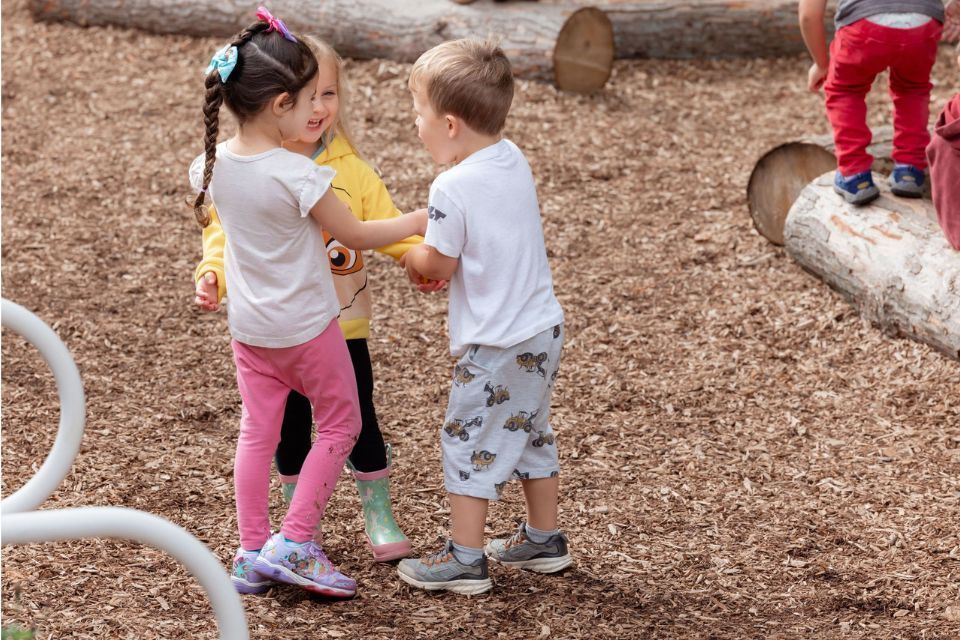
The elementary years are full of exciting growth and also fraught with tricky social situations. Children are learning how to communicate kindly and effectively, make and maintain friendships, manage their emotions, and solve problems, all while figuring out their place within a group. It’s no surprise that challenges arise.
As parents and caregivers, our instinct is to protect our children, especially when they come home upset. But how we respond matters. Our children do need to vent, and these moments offer powerful opportunities to teach problem-solving, resilience, and compassion.
Common Challenges
Throughout their childhood, children will face a series of challenges with their peers. As children experiment with language, they also experiment with the impact of their words. Silly “potty talk” might elicit a laugh from peers, but then a more serious curse word might cause upset or concern. This is also the time when children may lash out with more hurtful remarks about culture, religion, or skin color. Friendship struggles are also a regular part of the elementary years and can include feeling left out, lacking a “best friend,” or navigating shifting social groups. On top of all of this, some children struggle more with self-control, which can impact peer relationships. These challenges are not signs of failure. Rather, they are a normal part of learning how to relate to others.
Scenarios & Steps
Imagine your child comes home feeling excluded by a group of friends. After four or five times of seeing your child come home upset, you likely feel frustrated and protective. Should you email the teacher right away or help your child learn to self-advocate? Or perhaps your child is worried about a classmate who has tantrums, sometimes pushes, and disrupts the classroom. When you learn the child has ADHD and is receiving support, you may feel compassion, but you still don’t know how to help your child feel safe.
Both scenarios are different, yet these three easy steps provide a road map for a variety of social situations that may arise: start with empathy, pause before reacting, and then work on skill-building with your child.
Step One: Regulate Our Own Emotions
Children are highly attuned to our feelings. Before acting, it’s best to give ourselves time to process. We sometimes refer to this as the “24-hour rule.” This pause helps us avoid acting out of frustration and gives us space to see the bigger picture.
Step Two: Validate Our Child’s Feelings
Resist the urge to jump straight into fixing. Instead, focus on empathy and validation:
- “I’m so sorry that happened.”
- “That must have felt really unexpected.”
- “How are you feeling right now?”
This kind of acknowledgement lets your child know their emotions are normal and safe to express. It’s important to keep ourselves neutral, though. Our children don’t need us to absorb their emotions. Rather, they need a safe space to feel and express themselves without our emotional reactions.
Step Three: Teach Problem-Solving Skills
Problem-solving is not natural at this age, and our children need us to model and support the process. Here is a simple four-step approach:
Brainstorm: This is when we can work with our child to come up with two to three strategies. This is most effective when we keep the skill we want them to learn in mind (e.g. advocacy, making friends, respecting personal space).
Model: We can show them what the strategy looks like. It helps to use humor, stuffed animals, or even role play to make it engaging.
Practice: We want to give our child time to rehearse, just as one would when practicing a sport. During this practice, we can offer encouragement and feedback.
Plan: With our child, we then choose one strategy to try for a few days. We can help our child track progress and create a “Plan B” if needed.
This approach not only teaches social skills but also builds flexibility, persistence, and confidence.
Applying the Steps
Let’s think about the previous scenarios. In the first example of your child feeling excluded, maybe you decide that advocacy is the key skill. Together, you and your child can brainstorm ways to talk to friends. Then, you can select one strategy, practice it through role-playing, and set a plan to implement it for three days. If it doesn’t work, agree to regroup and try Plan B.
In the second example of your child feeling worried about a classmate’s behavior, it can help to both acknowledge your child’s feelings while also modeling being curious about what might be going on for the classmate. You may identify that a key skill is setting boundaries or communicating with an adult about feeling uncomfortable with the behavior. Again, the process is similar: help your child pick a strategy, practice it, apply it, and then reconnect to see how it worked or if it’s worth trying another approach.
In both situations, it can also help to let your child’s classroom teacher know what is coming up at home. Keep in mind, though, that sometimes our children want to vent to parents and caregivers without their teachers knowing. It helps to communicate with your child, “This sounds like something your teacher should know about. Let’s write an email together.” Or if you want to give the teacher a quiet heads-up, be sure to communicate that your child doesn’t know you are reaching out. This is also a great opportunity to see if your child’s classroom teacher has any recommendations for how to guide your child to respond if the situation arises again.
Educators value timely communication. If challenges arise at school, please notify teachers promptly so they can assist children in resolving the issue in real time, rather than weeks later when the dynamic has already shifted. When schools and families work together, children reap the benefits!
Compassion and the Bigger Picture
It’s natural to feel protective when our children experience social challenges. However, when we approach these situations with compassion rather than blame, our children learn to do the same. The skills our children learn (such as problem-solving, advocacy, and empathy) extend far beyond the classroom. They prepare our children to thrive in diverse communities, workplaces, and future relationships.
Supporting children through peer challenges is not about fixing every problem for them. It’s about guiding them to develop the skills, confidence, and compassion they need to manage relationships independently. We invite you to visit us at our school in Bozeman to see how we help children strengthen their social lives.