Unlocking the Child’s Secret Superpower: Understanding the Absorbent Mind
September 14, 2026

Unlike other species that are born with a predetermined set of instincts, human babies enter the world full of raw potential. When a child is born, we cannot know if they will become a master musician, an innovative engineer, or a creative chef. Children are continuously building the neural pathways, motor skills, and emotional foundation they need to become contributing adults.


Dr. Maria Montessori observed children through a scientific lens and concluded that this miraculous self-creation could only happen because the young child's mind operates in a fundamentally different way than the adult mind.

In The Absorbent Mind, Dr. Montessori observed:


"The child has other powers than ours, and the creation he achieves is no small one; it is everything. Not only does he create his language, but he shapes the organs that enable him to frame the words. He has to make the physical basis of every movement, all the elements of our intellect, everything the human being is blessed with. This wonderful work is not the product of conscious intention."


Long before modern neuroimaging confirmed how rapidly neural connections form in early childhood, Dr. Montessori identified this special developmental window and termed it the absorbent mind—a unique mental functioning active from birth to around age six.


What Does "Absorbent" Really Mean?


Dr. Montessori chose the word absorbent deliberately. It implies taking in information from the surrounding environment and integrating it directly into the whole self. What is absorbed becomes part of the child's very structure:


"Impressions do not merely enter his mind; they form it. They incarnate themselves in him. The child creates his own ‘mental muscles,’ using for this what he finds in the world about him. We have named this type of mentality, The Absorbent Mind."


From birth to age three, this absorption is unconscious. The young child effortlessly takes in sights, sounds, language patterns, and emotional cues without filter or fatigue. As they move into the primary years (ages three to six), this mind becomes conscious, allowing them to organize, classify, and refine what they have already absorbed.


The Power of the Prepared Adult: Modeling as Direct Instruction


Because children absorb their environment indiscriminately, our actions as adults become their primary learning materials. They take in not just our intentional lessons, but our tone of voice, our posture, and how we interact with our surroundings.


  • Calm Voices: If we desire quiet, peaceful spaces, we must speak with calm, gentle tones.
  • Grace and Courtesy: If we want children to sit during meals or treat materials with care, we must model those exact routines ourselves.


A Classic Story from the Montessori Classroom


In a toddler environment, a guide used to squat down gracefully in front of the low shelves every time she selected a material to present. Shortly after, the team noticed all the toddlers walking to the shelves, carefully squatting down, and then picking up their materials.


Even though squatting was physically more challenging for them than simply reaching down, they had unconsciously absorbed every step of the adult’s movement as the "correct" way to choose work.


Tending to the Prepared Environment at Home and School


In our classrooms at Bozeman Montessori, we carefully prepare our movements and environments to provide clear, beautiful models:


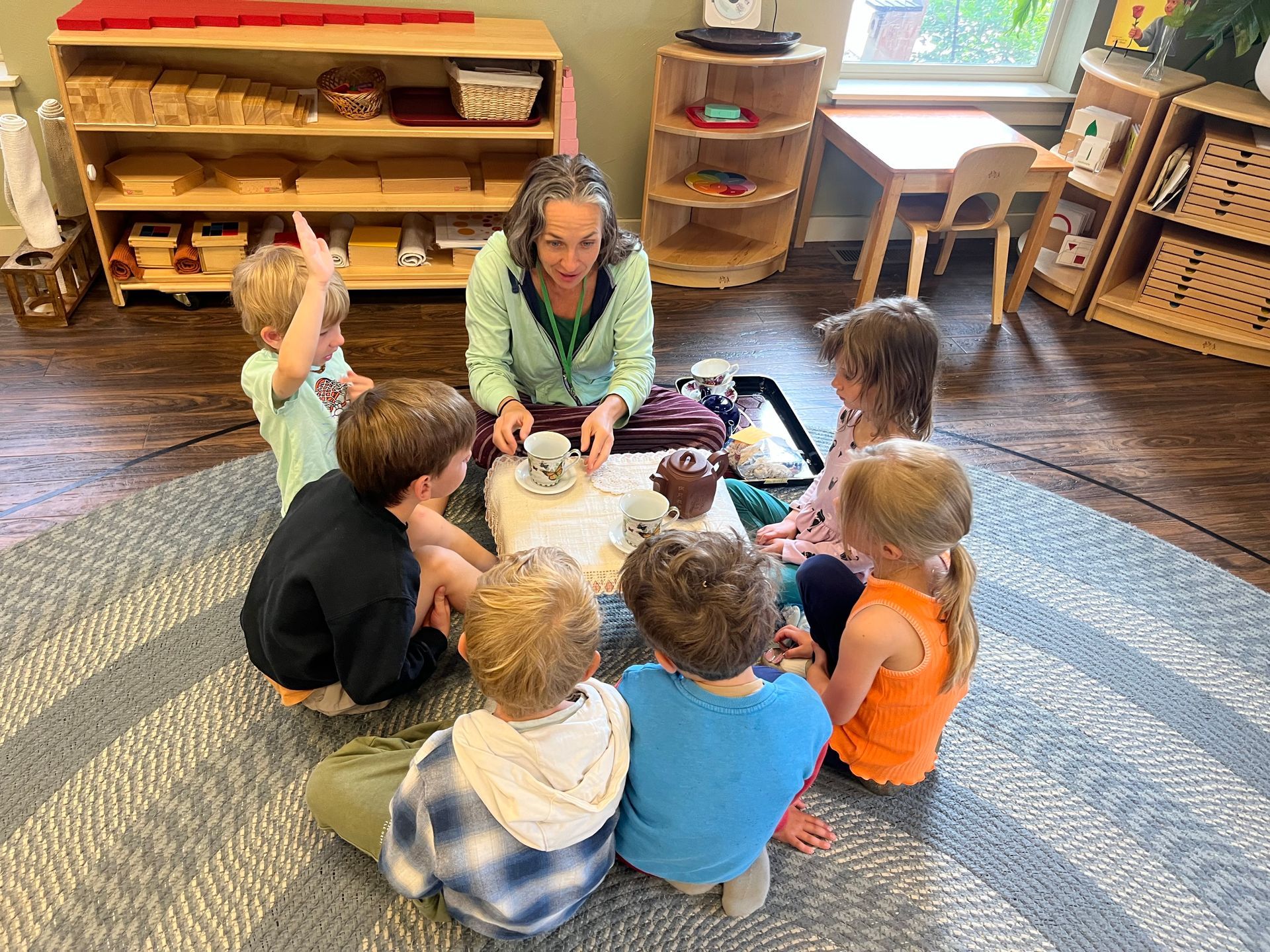
  • Shared Routines: When guides sit down for a snack, they follow the exact grace-and-courtesy steps as the children—washing hands, using real dishware, and sitting together family-style.
  • Refining the Process: Experiencing the environment alongside the children allows us to observe friction points: Are the child-sized dustpans accessible? Do the spray bottles fit small hands effortlessly? Is the space orderly and inviting?


Practical Tips for Parents: Seeing the World at Eye Level


Try kneeling or sitting on the floor in your child's room or living area to experience the room from their perspective:


  • What draws their attention immediately?
  • Is the space calm and orderly, or visually overwhelming?
  • Can they independently reach their clothes, books, or practical life tools?


Nurturing Every Child's Potential


Young children are hardwired to absorb the world around them effortlessly. By providing peaceful, beautiful environments and modeling intentional behaviors, we give their absorbent minds the rich foundation they need to thrive.


Experience the Prepared Environment in Action! We love sharing how our high-fidelity Montessori approach supports children during these crucial formative years. Schedule a tour today.
People sitting at a picnic table, with a field and fence in the background.
September 7, 2026
Discover how Bozeman Montessori’s prepared outdoor environments foster independence, sensory learning, and community through purposeful Practical Life activities.
August 28, 2026
We’d be thrilled to have you join us for an exclusive look around our campus!
Teacher helping children at a table with a board game in a classroom
July 30, 2026
Come see the Montessori environment in action! Now enrolling for the 2026-2027 school year.
montessori children with guide in tea lesson
June 26, 2026
We’re opening our doors for a special campus tour and we'd love for you to join us!
Three young children sitting on a couch, smiling in a bright indoor room.
June 15, 2026
Connect the Montessori classroom to nature. Discover how exploring Montana’s rivers helps young children develop spatial awareness and environmental respect.
Two children kneel on a classroom rug behind a colorful block maze on the floor.
June 1, 2026
In the Montessori tradition, we talk a lot about "following the child." Sometimes people mistake this for letting a child do whatever they want. But as those of us who have been in the trenches know, following the child actually means observing them through developmental periods so thoughtfully that we understand what they need before they even have the words for it. When it comes to mental health, this observation is our greatest tool, as it helps us prepare. Mental health in childhood includes resilience, the security of belonging, and the development of an "inner voice" that tells a child they are capable, eventually serving as their source of internal guidance. Supporting this development requires us adults to shift from being managers of their behavior to loving guardians of their emotional environment. The Foundation: Safety and Routine For children in the first plane of development (birth to age 6), the groundwork for mental health is laid through warm, secure relationships. In Montessori terms, this is the "prepared environment” of connection. We often say that children need consistency like they need air. We provide stability through routine—not a rigid schedule, but a predictable rhythm. When a child knows what comes next, their nervous system relaxes. Simple acts like involving them in everyday moments—letting them slice a banana or fold washcloths—give them a sense of agency. A child who contributes to the world around them is a child who feels capable and valued. This sense of "I can do it" is important, and sometimes we just have to get out of the way. The Elementary Years: The Why and the Who As children move into the second plane of development (ages 6–12), their mental health needs shift toward social belonging and moral understanding. This is the age of "Why?" and "That’s not fair!" At this stage, adults can check in on their feelings through everyday events. Did they get into a fight with their friend? Don’t rush to fix the sadness. Instead, sit with them in it. We can support their mental health by giving them the tools to solve their own social problems. Ask, "What do you think would help you feel better?" rather than handing them the solution. This builds the self-efficacy that helps buffer against anxiety and depression later in life. Learning the Hard Way Mental health isn't about avoiding the scary or hard things that come with growing up; it's about making sure your child never has to face them alone. It’s about cuddles, and hugs, and playing with your kids. It’s about recognizing that a tantrum isn't an attack on your parenting—it’s a child whose inner "prepared environment" has temporarily collapsed, and they need you to help them rebuild it. The Parent’s Work (The Inner Preparation) In Montessori, the "prepared adult" must do their own inner work to best be able to guide a child. Parenting can feel messy, and it rarely looks like the peaceful, perfectly-balanced life we might have imagined. Here is how to keep your own foundation solid: Honoring the "Gap": Make peace with the fact that your reality may not match your expectations. There will be days when you are not the “calm, cool and collected“ model you want to be. Forgive yourself. Your children don’t need a perfect parent; they need a regulated one who can apologize when they mess up and move forward. Mindful Co-Parenting: Whether you live in the same house or two, communication between co-parents must be clear and boundary-honoring. Children are emotional barometers; they feel the pressure of unspoken conflict. Aim for "functional transparency"—share the necessary information about the child’s needs without using the child as a messenger. Self-Care is Not a Luxury: You cannot pour from an empty vessel. In the Montessori classroom, a tired, burnt-out adult is not the example we want to set, nor is it an effective one. Taking ten minutes for a quiet tea or a solo walk isn't "ignoring" your kids; it’s calibrating your instrument so you can be the calm center they need. Boundaries as Love: Setting a boundary for yourself ("I need 5 minutes of quiet before I can help with that") teaches your child that you are a human with needs. This honors your humanity and models for them how to protect their own mental health in the future.
Children sit in a circle around a teacher at a table, sharing a small activity in a classroom.
May 18, 2026
Overbooking your child's summer? Learn why unstructured downtime and embracing a little boredom are vital for nurturing your child's creativity.
Montessori child working in the classroom
May 18, 2026
We’re opening our doors for a special campus tour and we'd love for you to join us! 
May 4, 2026
Discover how Montessori education champions character development, physical autonomy, and personal best over the cultural pressure of competition.
Show More