Montessori Materials Explained: The Flat Bead Frame
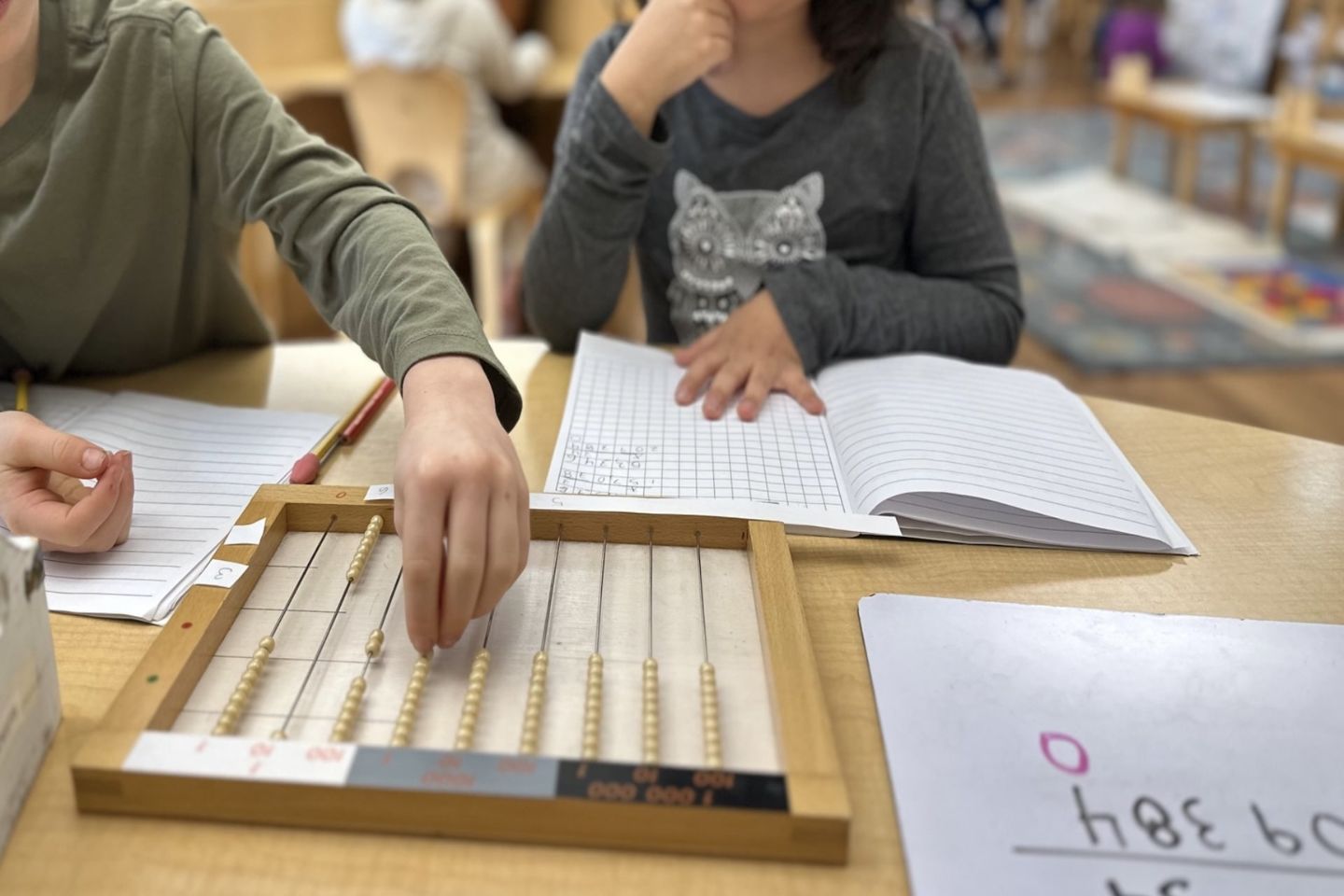
The Flat Bead Frame, also known as the Horizontal Bead Frame or Golden Bead Frame, is one of the most elegant bridges between the concrete and the abstract in the Montessori elementary math curriculum. It allows children to work with very large numbers, up to the hundreds of millions, while continuing to manipulate tangible representations of each place value.
Unlike many elementary materials designed for group exploration, this work is typically done individually (or with a partner), offering quiet moments of concentration and reflection amid the classroom’s collaborative hum.
From the Large Bead Frame to the Flat Bead Frame
At first glance, the Flat Bead Frame looks similar to the Large Bead Frame, but it represents a significant step forward in abstraction. The Large Bead Frame has seven horizontal wires and color-coded beads arranged by the simple, thousands, and millions period, thereby emphasizing the hierarchical nature of the decimal system.
In contrast, the Flat Bead Frame is organized vertically, with nine columns of golden beads, all identical in color, representing units through one hundred millions. The numerical categories are written across the top, and red zeroes are printed along the bottom to highlight the effect of multiplying by powers of ten. The golden color of the beads makes the material more symbolic, signaling that the child is now ready to move away from concrete color coding toward pure quantity and value.
Introducing the Material: Connecting the Known to the New
When introducing this material, we often begin by inviting a child to compare it with the Large Bead Frame. This connection helps the child orient to what is familiar while noticing what is new: the vertical organization, the placement of numbers, the red zeros, and the use of golden beads instead of hierarchical colors.
The child then begins with a simple multiplication problem, like 1,246 × 3. We write the multiplicand on a paper strip and place it beneath the wires so that each digit aligns with its corresponding place value. Using gray number cards or slips of paper for the multiplier, the child then moves the beads to represent each partial product. The process is rhythmic and deliberate: 6 units three times is 18 units (eight units and one ten)… 4 tens three times is 12 tens (four tens and one hundred)… The movement of beads down the frame creates a clear, physical representation of the multiplication process.
Moving Toward Abstraction: Powers of Ten in Action
As the child progresses, the Flat Bead Frame becomes a tool for exploring long multiplication (also called compound multiplication) and multiplication by powers of ten. When the multiplier contains tens, hundreds, or thousands, the child learns to physically shift the multiplicand to the left—mirroring the way zeros are added in written notation. The red zeroes along the base of the frame make this concept immediately visible. What might otherwise be a rote rule (“just add a zero”) becomes an embodied experience of place value and the movement of quantity through hierarchical orders.
A Continuation of Earlier Montessori Work
This material builds on experiences children had with the Bank Game at the primary level, when they would work as a group to exchange quantities of 10 for the next category. On the Flat Bead Frame, however, the work becomes deeply personal and precise. It requires concentration, accuracy, and an understanding of the relationships between categories. These qualities help build the foundation for true mathematical abstraction.
The Mathematical Mind in Motion
Through this work, children reinforce their multiplication facts, internalize the commutative law, and gain confidence in working with large numbers. More importantly, they begin to grasp that mathematics follows a consistent and logical structure, one they can visualize, manipulate, and eventually imagine without the aid of concrete materials.
A Quiet Revelation
The Flat Bead Frame exemplifies Montessori’s belief that “the hand is the instrument of the mind.” As children move the golden beads, their understanding of place value and multiplication deepens. The process of working with the Flat Bead Frame provides children with a conceptual leap from seeing mathematics as a set of operations to recognizing it as a beautifully ordered system.
Visit us in Bozeman to see how what begins as a physical exercise in moving beads becomes, over time, a quiet revelation and a process of mathematical thinking. This is Montessori math at its best!